Creance
H is for HawkThe Creance is a long line used in the early stages of training a hawk, when the bird is learning to fly to a raised glove and whistle. In Helen Macdonald’s account it is not simply a restraint: it makes a controlled lesson possible, but cannot substitute for the timing, observation, and care that teach the hawk what is expected. Its contrasting uses in Mabel’s training and T. H. White’s work with Gos make the line a small but consequential measure of the difference between support and force.
Construction and handling
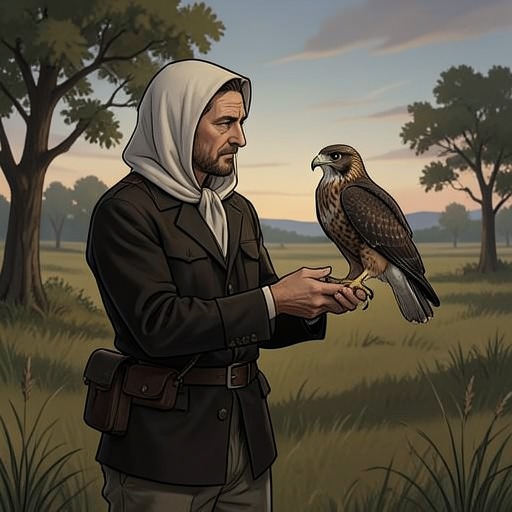
For Mabel’s calling-off lesson, Macdonald threads the Creance through the swivel at the end of the hawk’s jesses and secures it with two miniature falconer’s knots, testing that they hold. She plays out fifteen additional feet of line and puts the remainder deep in a zipped pocket of her hawking waistcoat. The arrangement keeps the loose length contained while leaving enough line for the exercise. She then removes Mabel’s leash from the swivel. Knots, swivel, jesses, leash, and line form a practical system: the Creance is attached where it can follow the hawk’s movement, while the falconer retains control of its available length.
The tool is used within a measured progression, not as an invitation to let a young hawk fly without limit. Macdonald begins by asking Mabel to move from a veranda rail to her gloved fist for food, first from six feet and then from eight. After the lesson, she threads the leash back through the swivel and unties the Creance. The line belongs to this stage of training; it is removed when the exercise is over. The account presents its management as part of the lesson’s discipline, alongside the food reward and the falconer’s attention to the bird’s response.
Calling-off lessons
A calling-off lesson teaches a hawk to fly promptly to an upraised glove and a whistle. Macdonald emphasizes that an immediate response matters: if the hawk does not come, prolonging the attempt with repeated calls and whistles teaches little, so the falconer should end the session and try again later. In this method the Creance makes a bounded practice possible, but the instruction comes through a clear request and timely reward, not through hauling the bird toward the handler.
Mabel’s first lesson proceeds quickly. She flies to Macdonald’s glove at six feet, then repeats the flight from farther away. On the third repetition she leaves the rail while Macdonald is turning away and lands at her side. The hawk receives food after each successful flight. Macdonald ends the session by reattaching the leash and removing the Creance; she is pleased enough with the result to sing on the way home. The scene gives the line a limited, specific function: it accompanies the early exercise, while the hawk’s response and the lesson’s reward establish the behaviour the exercise is meant to teach.
White, Gos, and a failed use of the line
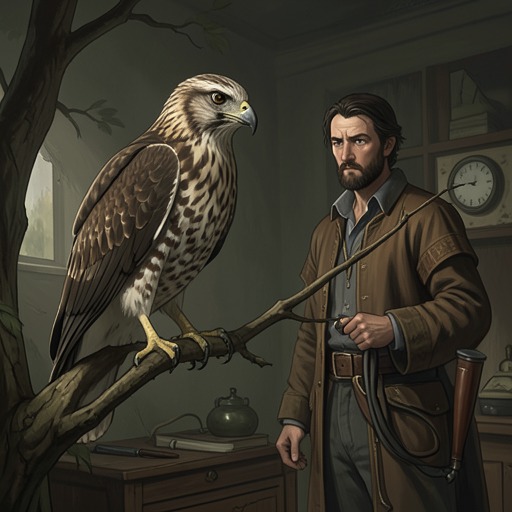
T. H. White’s first attempt to call Gos illustrates what happens when the Creance is used to compel movement rather than teach a response. White holds out a glove and waits for the hawk to come. Gos watches but does not understand what is expected. After an hour of waiting, White takes hold of the line and pulls, dragging Gos down from his perch. The hawk returns to the railing, and White pulls him down again. Only after this has happened repeatedly does Gos begin to walk toward him; White then retreats, and the hawk follows. The eventual flight to the fist is followed by a rabbit reward, but the account stresses that the preceding pulling has not communicated the intended lesson.
Macdonald sets this episode against the calling-off rule she follows with Mabel. White’s difficulty is not presented as a fault in the Creance itself, but as a failure of instruction: Gos is not given a clear, successfully rewarded route to the glove, and the line is used to force him from his perch. Macdonald also objects to White’s retreat once Gos has begun to approach. The contrast shows that control of the line is not equivalent to understanding the hawk. A tool can limit where a bird goes, yet still leave it uncertain about what the falconer wants.
A line that cannot be trusted
The account returns to the danger of a tether through White’s later attempt to give Gos more freedom. At The Ridings, he attaches six yards of tarred twine between Gos’s swivel and a bowperch outside the barn, intending that the hawk be able to fly out and return. The twine has already snapped twice and has almost no breaking strain, making it a poor and unsafe substitute for dependable equipment. White leaves Gos tethered while he goes to attend to other tasks. When the hawk bates from the barn, the line breaks; White returns to find the perch empty and the frayed end on the ground. Gos is gone.
That escape gives the line a consequence beyond the training exercise. In Mabel’s lessons, the Creance is carefully knotted, its loose length secured, and its use ended when the session is complete. In White’s later arrangement, weak twine is meant to provide freedom but cannot reliably hold the hawk. The contrast is not a simple opposition between restraint and release: a line can make early training possible, become an instrument of coercion when used without understanding, or fail as protection when its material condition is ignored. Across these episodes, the Creance marks the practical and ethical limits of control in falconry.